

In product-led companies, what a rep closes and what a rep creates are two different numbers.
In a PLG company, you find out whether your sales team works on the day your top of funnel stops growing.
Until then, everything looks fine. Customers sign up, convert, and expand. Reps are there to catch it. Bookings rise with headcount. Nobody asks hard questions about a line that goes up and to the right.
Then signups flatten, and sales flattens with them. Same reps. Same accounts. Same playbook. Less output. The rep was never driving the revenue. The rep was standing where it landed.
You can find this out years earlier by answering the one question that actually matters before your next planning cycle:
If you hired one more rep tomorrow, how much ARR would exist a year from now that otherwise would not?
If you cannot answer that with a number and a method, this article is for you.
In a sales-led company, that question is trivial. No rep, no deal. In a product-led company, what a rep closes and what a rep creates are two different numbers, and that gap is where a lot of PLG companies quietly lose the plot. They size the sales team on the first number. They pay it on the first number. They route accounts on the first number. Then the funnel slows, and the second number shows up all at once.
It is one of the most common and least understood ways great PLG businesses stall.
The baseline isn’t zero anymore
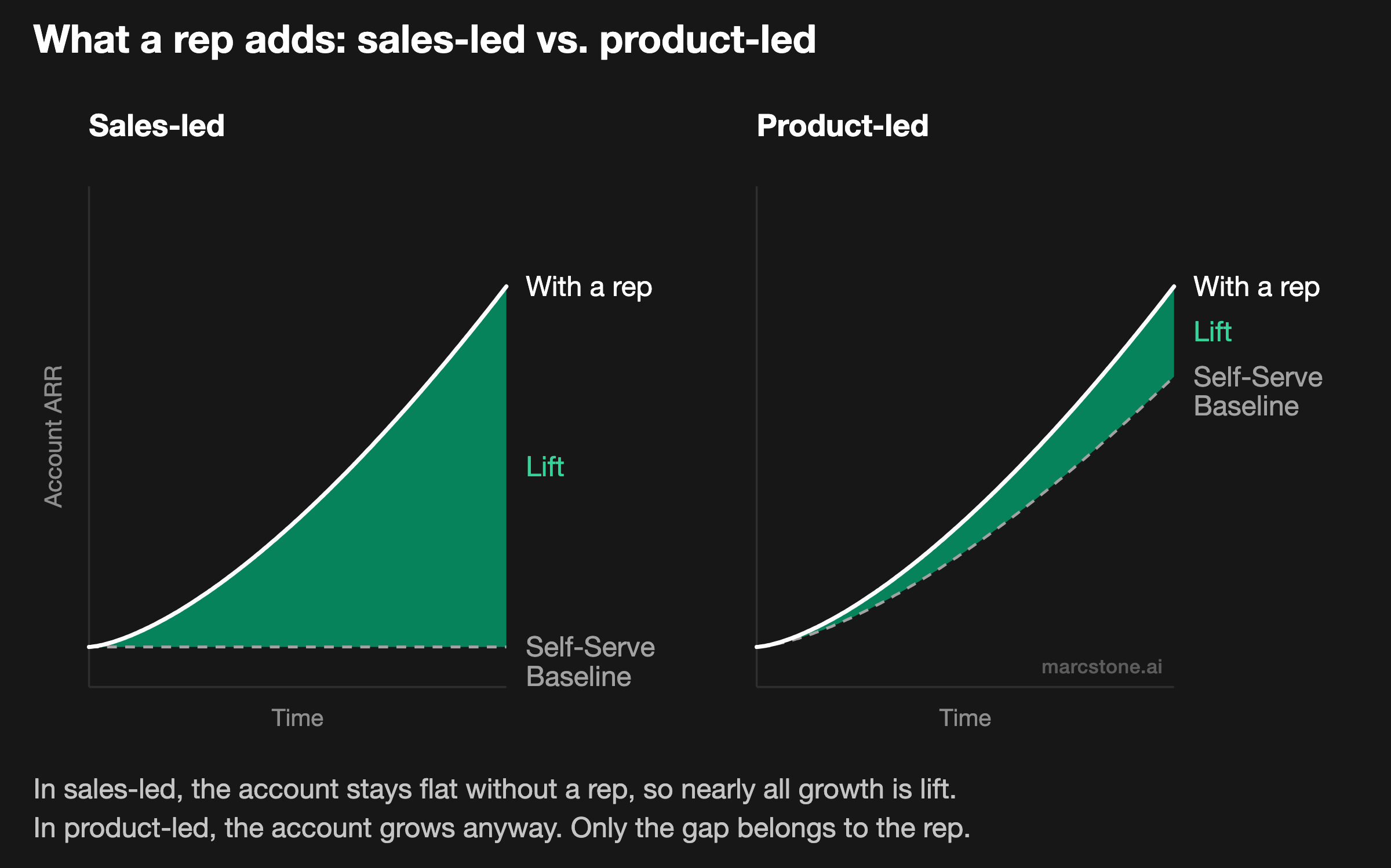
The “tech company” sales playbook was built on one assumption: without a rep, there is no deal. Buyers do not stumble into six-figure contracts, sign them, and roll them out across the company on their own. Every dollar a rep closed was a dollar that would not have existed without them. The counterfactual was zero, so nobody had to measure it.
That assumption made the whole system legible. Hire a rep. Close deals. Hire more reps. Close more deals. Pay a percentage of what closes. Route accounts by size, because bigger accounts mean bigger deals. It worked for decades.
PLG broke the assumption. Customers find the product, adopt it, pay for it, and grow into it without talking to anyone. The accounts that reach a sales team are, almost by definition, the ones already growing. The counterfactual is no longer zero. It is a curve, and often a steep one.
Most comp plans, headcount models, and routing rules haven’t evolved with this reality. They still treat every dollar that passes through a rep as a dollar the rep created.
Paying for growth that was already coming
PLG companies tend to pay customer-facing teams (AEs, account managers, CSMs, solutions architects) in one of two ways.
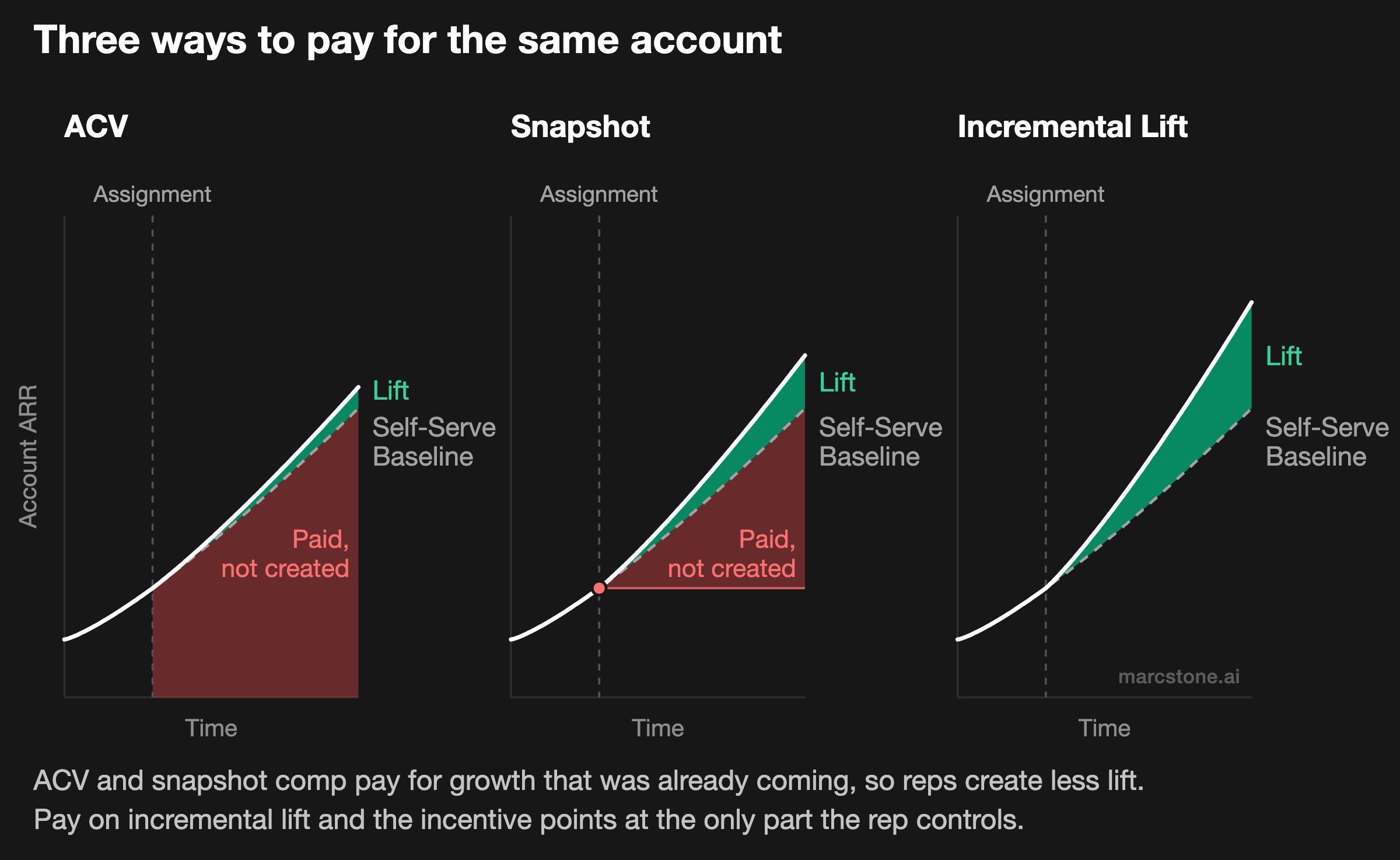
The first is ACV-style comp: the rep gets credit for the whole account. It is the enterprise plan transplanted into a product-led business, and it pays for the entire curve: the revenue that existed before the rep arrived and all the growth that would have come without them.
The second looks smarter. Snapshot the account’s ARR on the day it is assigned, then pay the rep on growth above that line. It feels fair. The rep does not get paid for what the customer was already spending.
It has the same flaw, one step removed. Organic growth does not stop on assignment day. The account was on a curve before the rep showed up, and it stays on that curve after. Snapshot comp pays for everything above the assignment line, and in a healthy PLG business, most of what sits above that line was coming anyway.
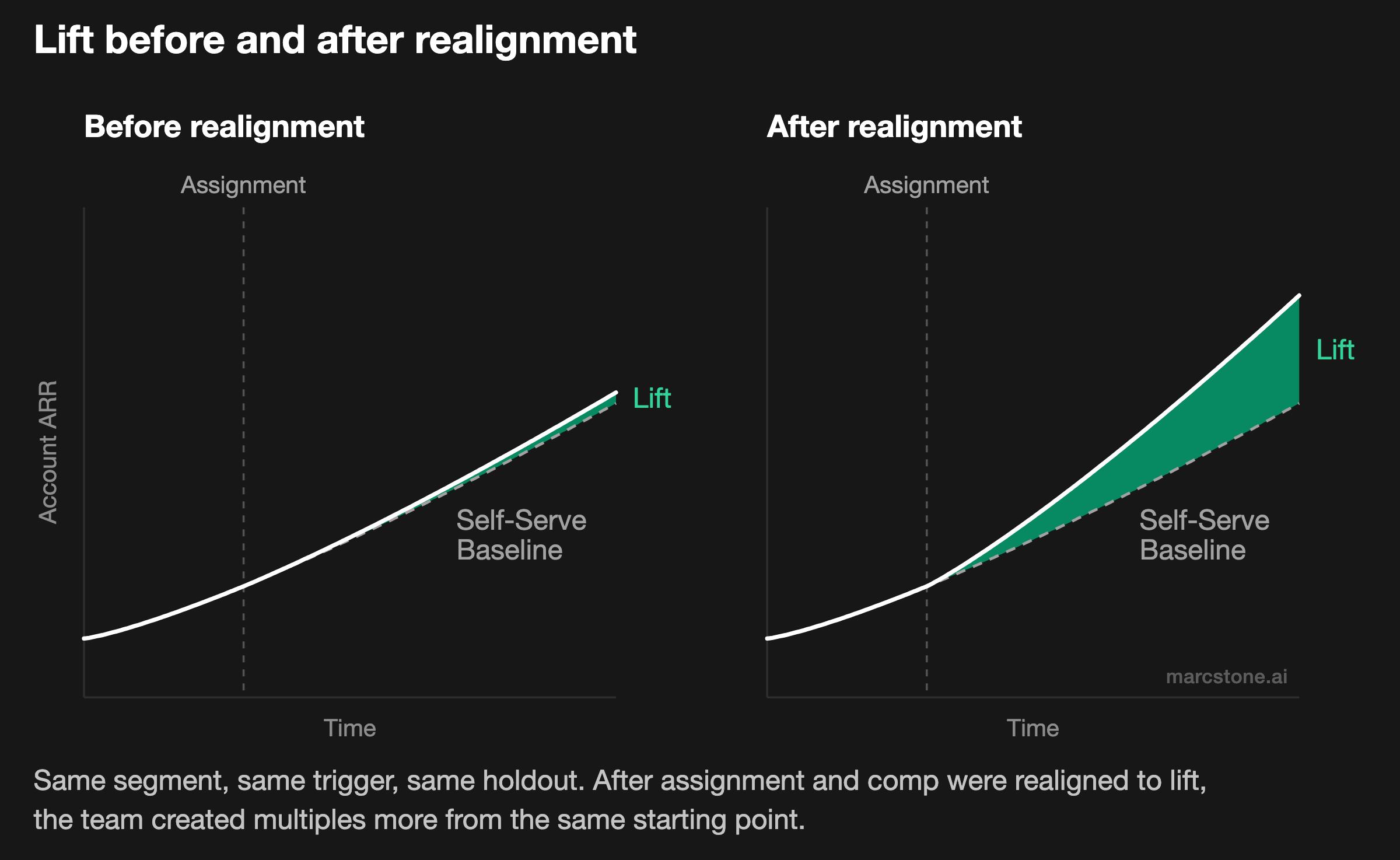
Only one number measures what the rep actually did: the gap between the account’s real path and the path it would have taken without them. That gap is lift. Everything else is paying for the curve and creates a notorious misalignment between sales activities and sustainable company growth.
The usual rebuttal is the commission rate. Reps only earn a small percentage of that growth, the argument goes, so they carry bigger books and the company keeps most of the upside. The organic part is priced in.
It is not. A lower rate changes how much you overpay. It does not change what you pay for. Every dollar above the line still earns the same commission, whether the rep created it or the product did, and the organic dollars are the easy ones. They show up in every account, whether the rep does great work or none at all. So the rational play is to carry more accounts and reach them sooner, not to go deep on the few where a human changes the outcome. Nothing in the plan points the rep at the blue wedge.
And the discount lands on the wrong people. The team doing real work earns the same reduced rate on the lift it actually created, while the harvesters keep collecting on the curve. A haircut on the whole curve taxes the lift and subsidizes the harvest.
The spiral
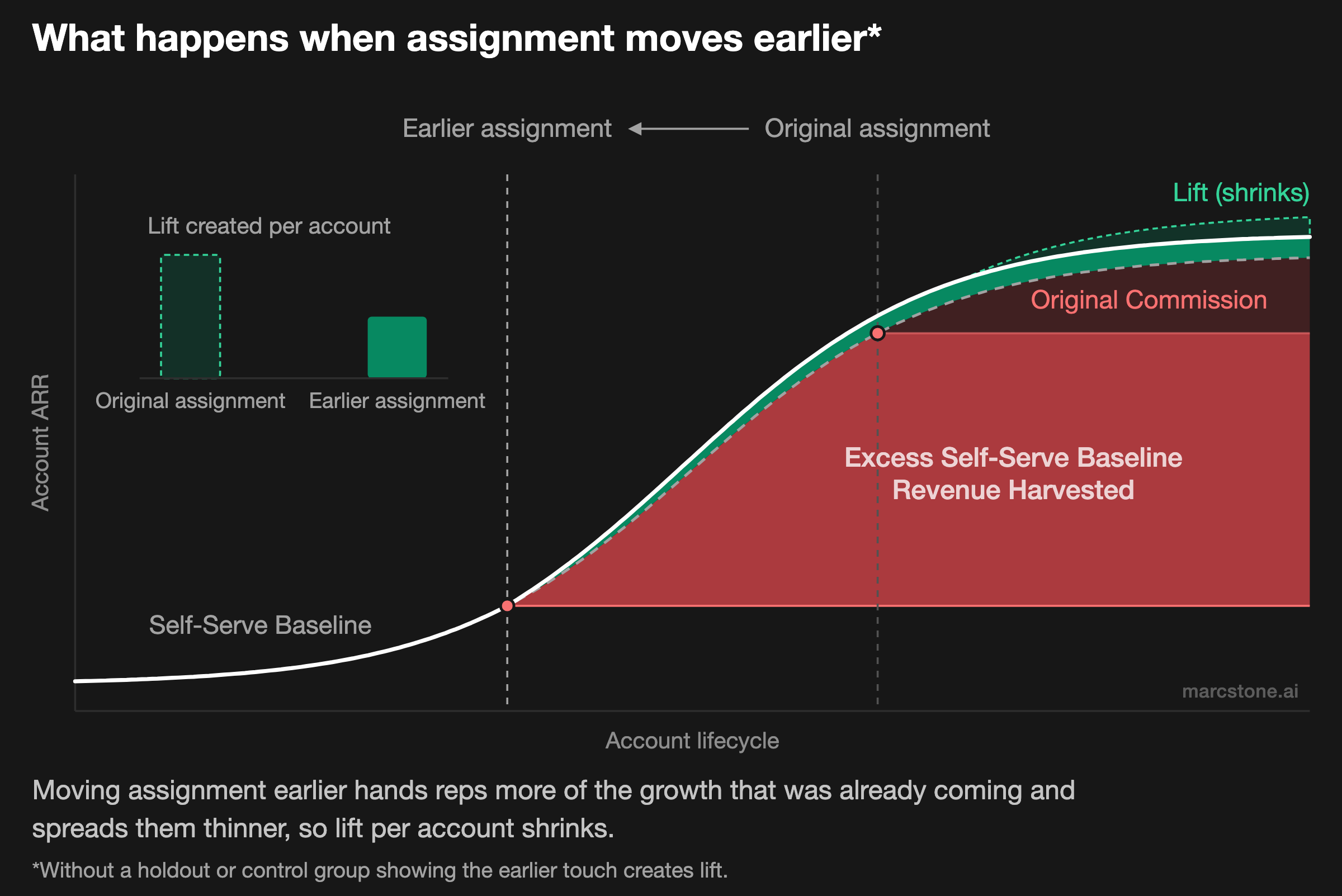
Snapshot comp carries a quiet incentive. The earlier a rep gets an account, the lower the snapshot, and the more organic growth sits above it.
Reps and managers figure this out fast. They lobby to lower the assignment trigger (the point where an account gets handed to a rep): a smaller spend threshold, a lower usage score, an earlier lifecycle stage. Leadership usually agrees, because more coverage sounds like more growth.
Here is what happens next. Accounts arrive earlier in their lifecycle and less qualified. Reps collect the steepest part of the organic ramp, the stretch where young accounts grow fastest on their own. Comp goes up. Attainment looks great. Lift goes down, because less and less of the growth the rep is paid on has anything to do with the rep.
Then the coverage model notices that more accounts clear the trigger, and it asks for more reps. You hire them. The cycle repeats.
Nobody in this loop is acting in bad faith. Every step is a rational response to the plan. That is exactly the problem.
Doing the wrong thing efficiently
In 1963, Peter Drucker wrote one line that rings as true today as ever and is etched deep in my psyche:
“There is surely nothing quite so useless as doing with great efficiency what should not be done at all.”
- Peter Drucker
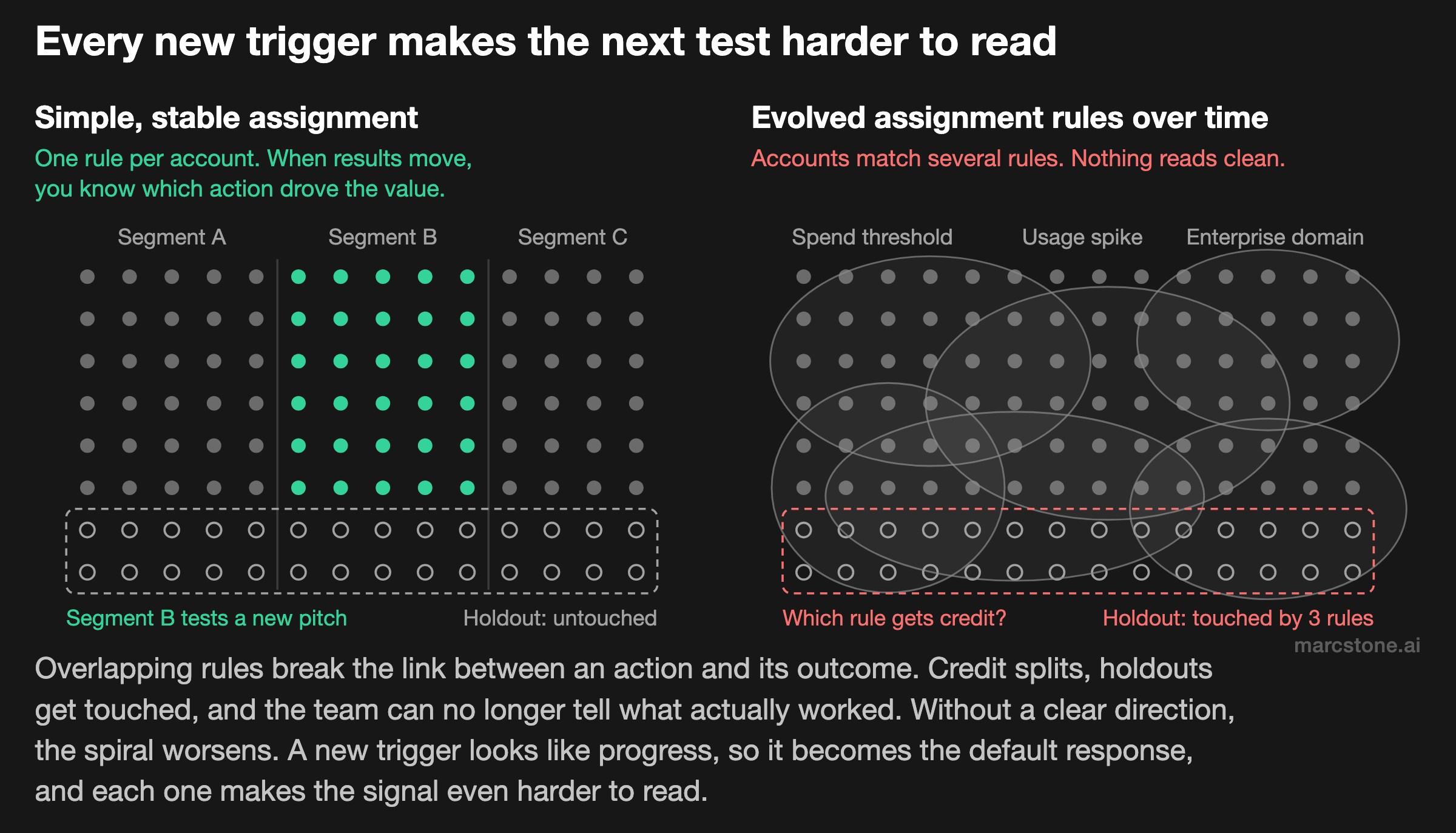
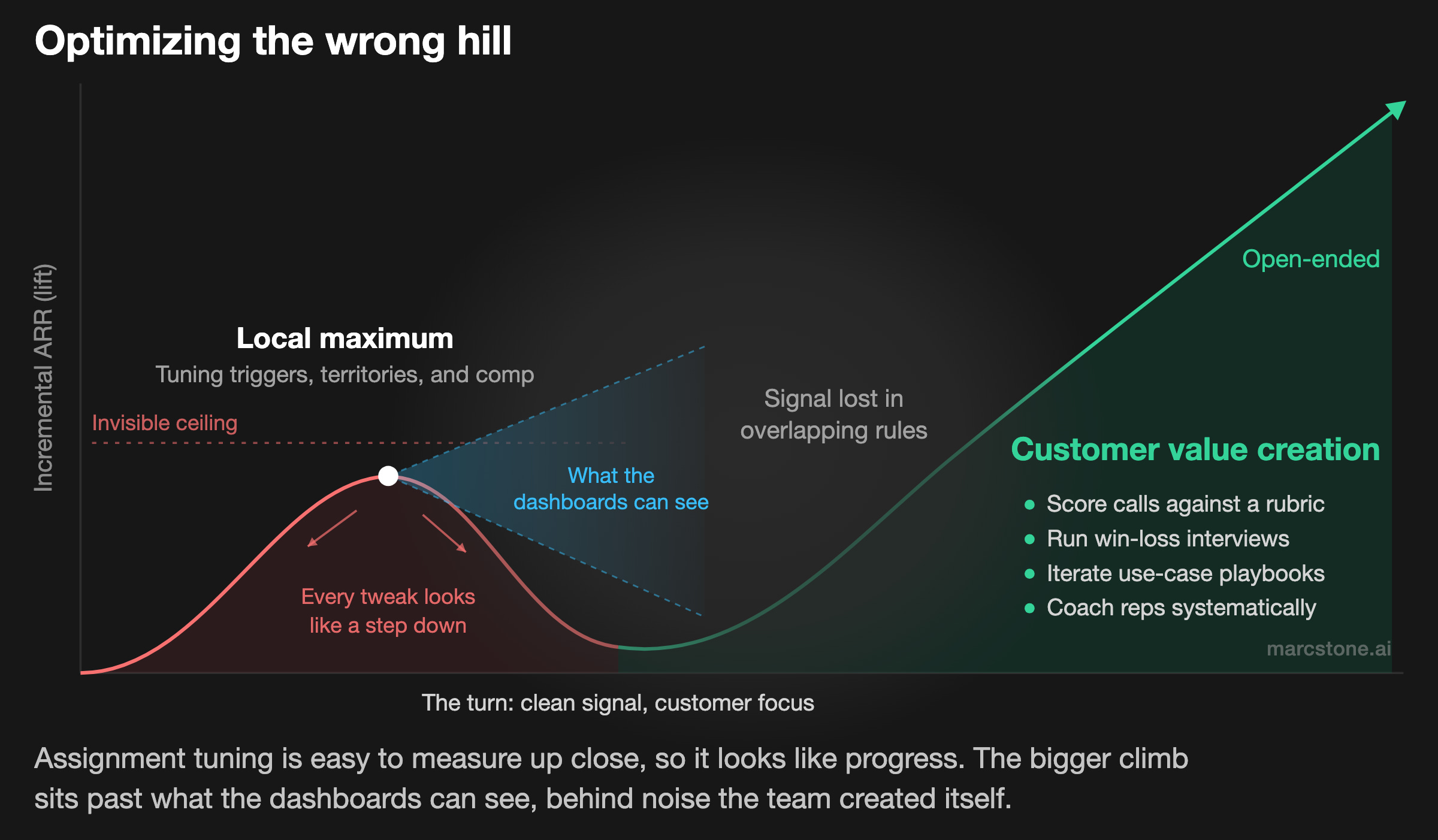
Big PLG sales orgs get very good at efficiency promoting activities. As they scale, they add layers. Managers. RevOps. Territory rules. Routing tools. Attribution disputes. Comp committees. Each layer makes sense on its own. Together they generate so much operational noise that nobody can see the question underneath: is any of this incremental?
Complexity hides incrementality.
So the org keeps scaling the thing it cannot evaluate.
It can get worse than wasteful. It can go net negative. The team costs more than the lift it creates. Reps discount revenue that would have arrived at list price. Buyers who wanted to self-serve get pulled into calls, demos, and procurement cycles they never asked for. The sales org stops being a growth engine and becomes a very expensive toll booth on top of one.
None of it shows while signups are growing. Rising demand covers everything. Then the funnel slows, the tide goes out, and it all shows at once. Pipeline thins. Attainment slides. The same leaders who asked for more headcount start asking for more leads.
That is the tell. If output per account worked moves with the signup chart, the team was harvesting demand, not creating it.
The honest version
This is not an argument against sales. It’s an argument for building great, incrementally valuable go-to-market interactions. Human engagement is valuable and enjoyable for everyone when employed at the right place and time. A great account manager or solutions architect can change an account’s trajectory in ways the product never will. The job is to make sure they’re incentivized and aligned to do just that.
The honest version compares every account against a counterfactual baseline and pays on the gap.
I’ve participated firsthand in leading this change and the clarity it creates is a sweeping wind of fresh air. After the restructuring of assignment and compensation toward incremental value creation the team produced multiples more lift from the same starting point. The difference was entirely in what the team did: sharper outreach, a clear value proposition, better follow-up material, targeted upsell recommendations, and program operators tuning all of it behind the scenes. The conversation shifted from entirely triggers, signals, and lead assignment to hunting for ways to deliver more customer value overnight.
A comp plan that cannot tell a great team from a weak one is not measuring the team. It is measuring the product.
Lift-based comp sees the difference immediately. And when reps are paid on lift, they do different work. They stop chasing accounts that are already growing and start asking what they can add to the ones in front of them.
Who versus what
That is the opposite of where most PLG sales orgs put their energy. In my experience, sales and RevOps work the same problem over and over: who to talk to. More triggers. Earlier contact. New intent signals. Another scoring model, another routing rule, another territory redraw. Every quarter the targeting gets more sophisticated. Every quarter the calls sound the same.
Targeting feels like leverage. In PLG it is mostly harvesting. Each new trigger is another way to reach revenue sooner, and reaching revenue sooner usually means reaching growth that was already on its way. It is the spiral with a green sales dashboard and a red company one. Targeting for lift is the job. Targeting for sooner is harvesting.
Here is a simple diagnostic. Listen to what your sales leadership spends its time on. If it is triggers, signals, routing, territories and getting to accounts earlier, the team is optimizing who, not what. If it is what happens on the call, how many real meetings reps are having, and training that makes each conversation more valuable to the customer, it is optimizing what.
In most PLG companies, who a rep talks to should be boring. A few simple rules that rarely move. Everything interesting should happen after the handoff: the architecture review that heads off a painful migration, the security answer that unsticks procurement, the recommendation that fits how the customer actually uses the product. That is where lift comes from, and it compounds when a team obsessively improves it.
The who should be boring. The what should be the obsession.
Manage inputs, not outputs
Even with lift as the scoreboard, you cannot manage it directly. Lift is an output. So is ARR. So is attainment. Outputs tell you how the quarter went. They do not tell anyone what to do on Monday.
Output metrics are the results everyone cares about, but they lag, and nobody can move them directly. Input metrics are the activities a team controls, chosen because they drive the outputs. Good leaders watch both and manage the inputs.
Manage a team on an output and it will find the fastest way to move that output. For a PLG sales team managed on bookings and attainment, the fastest way is harvesting. Manage it on the right inputs, and the easiest way to hit the number becomes the work that creates lift.
The first input you pick is usually wrong. Track account reviews and within a quarter you will have plenty, many of them thirty-minute calls that changed nothing. So you revise: reviews that led to a documented change in the customer’s design. Pick an input, watch what it does to behavior, and keep revising until the input and the lift move together.
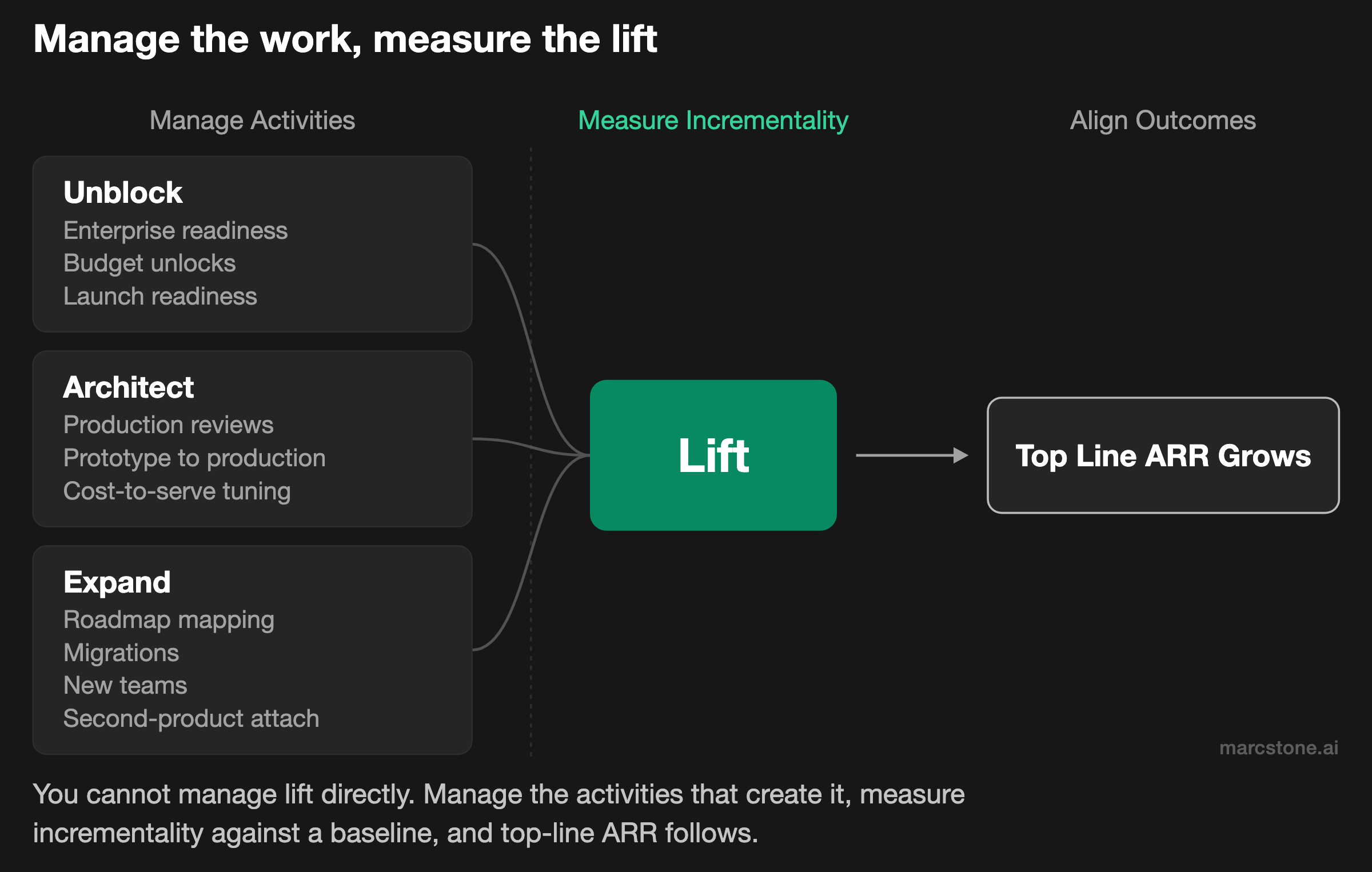
For customer-facing teams at PLG AI, SaaS, and developer infrastructure companies, the inputs that create lift are the things the product cannot do on its own. They fall into three groups.
Unblock. The walls a self-serve buyer cannot climb alone.
Enterprise readiness. Security reviews, SSO, compliance, DPAs, procurement.
Budget unlocks. Buying through a cloud marketplace commit or next year’s plan, so growth does not wait for a new budget line.
Launch readiness. Load tests and a scaling plan before the customer’s big launch.
Architect. Help the customer build bigger than they would alone.
Production reviews. Data model, performance, and security designed for scale before the customer hits the wall.
Prototype to production. Evals, latency, cost per request, guardrails. Most AI prototypes die between the demo and the shipped feature.
Cost-to-serve tuning. Make today’s workload cheaper so the next one fits the budget. It looks like giving money back. It wins the next project. Measured over the full horizon, the next project more than covers it.
Expand. Workloads the customer would not have brought on their own.
Roadmap mapping. Learn what they are building next quarter and design it onto your platform before they shop around.
Migrations. Move off a competitor, a legacy system, or an in-house build. Switching costs keep these out of reach of self-serve.
New teams. Spread from the team that found the product to the teams that have not.
Second-product attach. A product that solves a problem they have not connected to you yet.
Manage the activities. Measure the incrementality. Align the outcomes. Top-line ARR grows.
The toolkit
1. The input test. Take every rep in a segment over the last two quarters. Next to each, put two counts: accounts they were handed, and real input activities they delivered (a production review that changed a design, a migration shipped, a security review closed). Then see which count explains the revenue. If the biggest books win no matter what the rep did, the team is harvesting demand. If the reps doing the most input activities win, even with smaller books, the team is creating it. You do not need a slowdown to run this. It is a diagnostic, not proof; the holdout below is the proof. If you cannot fill in the second column, that is your answer. Nobody, including the reps, knows what the valuable work is.
2. Baseline and holdout. For each segment or ICP you can measure, chart the typical revenue path of accounts from the moment they hit your assignment trigger (or milestones like paid conversion, $1,000 ARR, etc.), with no sales touch. That is your baseline. Validate it by randomly holding a slice of eligible accounts (say 10 to 20 percent) out of coverage each quarter. If holding out even a few accounts feels too risky, notice what that means: you are certain coverage matters, and you have never checked.
3. Lift-based comp. Define lift as an account’s ARR at a fixed horizon, say 12 months after assignment, minus what the baseline predicted for it. Pay only on that. Lift is a smaller number than total growth, so pay a higher rate per lift dollar and on-target earnings still work. This also kills the spiral. Taking an account earlier no longer pays more, because that is where the baseline is steepest. In practice, pay quarterly on running lift with a 12-month true-up, measure at the book level, and publish each account’s baseline at assignment.
4. Hiring and assignment rules. Add the next rep only while expected lift per rep beats fully loaded cost by your target multiple. Send reps the accounts where a human changes the trajectory (an enterprise wall, an architecture limit, a second-product fit), not the ones already growing fastest. Set these rules once and leave them alone; the energy belongs in what reps bring to each account.
Answer the Question That Matters
If you hired one more rep tomorrow, how much ARR would exist a year from now that otherwise would not? Not bookings. Not attainment. Not pipeline influenced.
Top-line, incremental, finance-certifiable revenue that would not exist without that person. The kind that should get a sales leader promoted.
If you can answer with a number and a method, you know how big your sales team should be, what to pay it for, and where to point it. That team might be bigger than today’s or smaller. Either way, you will know what every seat is worth.
If you cannot answer it, you do not have a sales problem yet. You have a measurement problem. And it becomes a sales problem the day your funnel slows.
If you have run a holdout on sales coverage in a PLG business, I want to hear what you found. Find me on LinkedIn.